Measuring Brussels sprout tenderness with a fork and a kitchen scale
I air-fried 54 Brussels sprout halves at nine time and temperature settings and measured tenderness with a kitchen scale, a fork, and the click in a video's audio track. The measurement worked. The design had fewer replicates than it looked like.
How much force does it take to push a fork through an air-fried Brussels sprout, and how much do cooking time and temperature change that? I found out in my kitchen with an air fryer, a scale, and a fork.
Measuring “tender”
“Nicely tender” isn’t a number. So I put each cooked half on a kitchen scale, zeroed it, and pushed a fork straight through. The reading at the moment the fork hits the glass plate is the force it took, in grams. Lower is more tender.
The display changes too fast to read by eye, so I filmed every push. The fork clicks when it reaches the plate, and the click shows up as a spike in the audio waveform in any video editor. I scrubbed to each spike, paused, and read the scale.
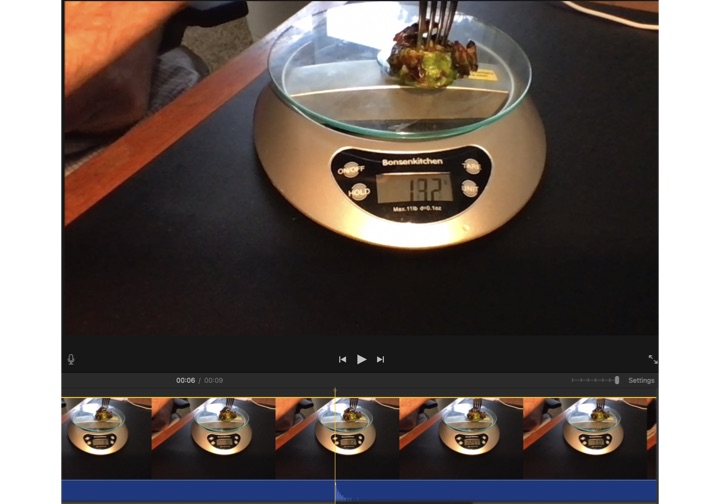
The setup
Three temperatures (380, 390, and 400°F) and three times (9, 10, and 11 minutes) gave nine batches of six halves, 54 sprouts in all. I weighed every half raw, since a bigger sprout should need more cooking, and put that weight in the model as a covariate. Everything in the basket gets the same time and heat, so cooking is the whole-plot treatment, and I analyzed it as a split plot.
Mean force in grams at each setting:
| 9 min | 10 min | 11 min | |
|---|---|---|---|
| 380°F | 142.7 | 99.0 | 71.2 |
| 390°F | 68.0 | 70.2 | 84.8 |
| 400°F | 49.4 | 38.2 | 52.2 |
Temperature mattered most. The linear temperature term was strongly significant, and so was the time-by-temperature interaction. At high heat, cooking longer made things worse: the outer leaves crisped and took more force to get through. Each extra gram of raw weight added about 1.1 g of required force, though that estimate was noisy.
Using it as a recipe
If the model was any good, I should be able to pick a tenderness and get a time and temperature back. I aimed for 130 g. The model said 11 minutes at 390°F, so I cooked six more.
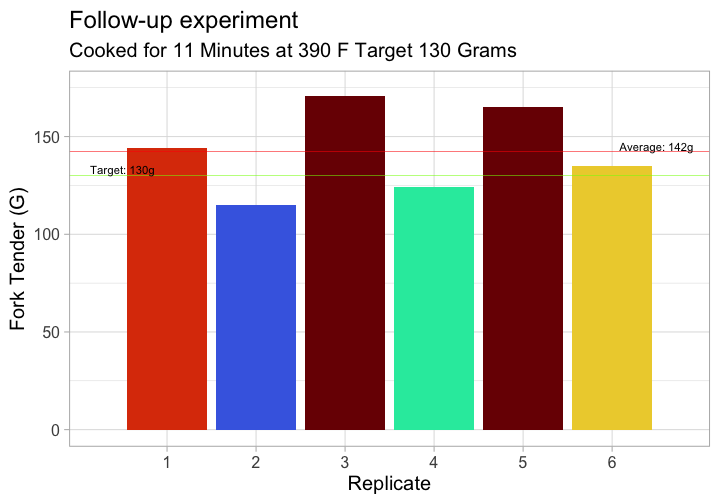
They averaged 142 g, close enough that I called it a success.
Batch to batch
The follow-up also taught me something about the design. The first batch at 390°F for 11 minutes averaged 85 g, and the follow-up at the same setting averaged 142 g. Two batches cooked the same way landed further apart than most of the settings in the table.
That’s batch-to-batch variation, and it’s what the time and temperature effects should be tested against. The six sprouts in a basket share one batch, so they’re subsamples of it, and with each setting cooked once I didn’t have a way to estimate it. I’d read the significance results as more tentative than they look.
Next time I’d cook fewer sprouts per batch and run more batches, each setting at least twice, in random order. I’d film it again, with a scale that samples faster.